
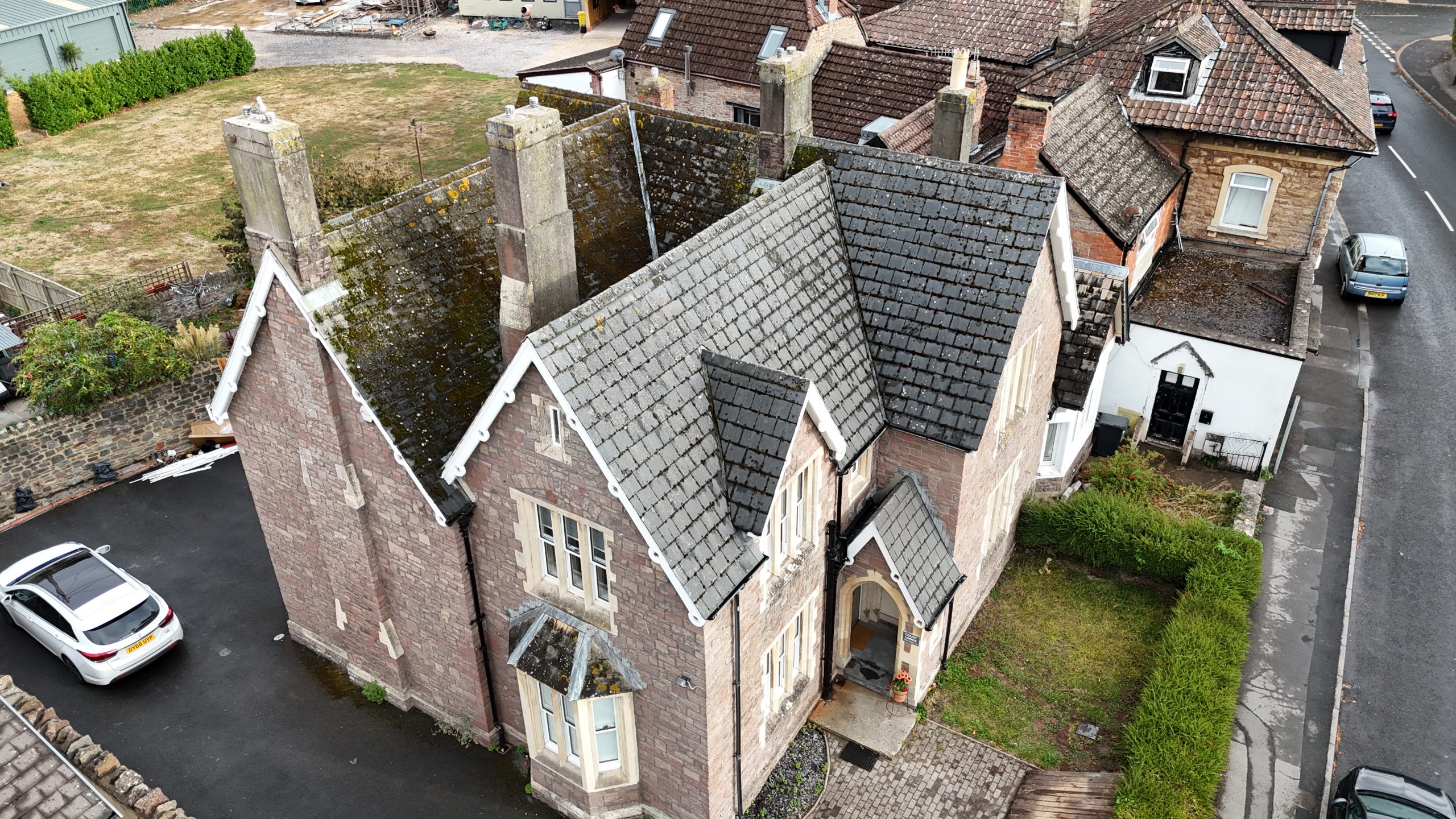
We recently secured planning approval for the conversion of Court Lodge, 105 High Street, Portishead, changing the property from a former office building back into a single family dwelling within the Portishead Court Farm Environs Conservation Area.
This project demonstrates the importance of detailed planning strategy, heritage-led architectural design, and robust technical documentation when dealing with complex conservation area planning applications and flood risk constraints.
The building at Court Lodge was historically residential before being converted into offices during the early 1990s through sequential planning approvals. A previous attempt by another practice sought to convert the property back into residential use under Class MA permitted development rights via prior approval application reference 24/P/2203/CM2A. However, the application was refused by North Somerset Council.
Importantly, the refusal was not based on the principle of residential conversion itself. In fact, the officer’s report confirmed there were no objections regarding transport impacts, parking, conservation area impact, natural light, or noise impacts.
Instead, the refusal primarily related to two technical planning issues:
- Historic restrictive conditions attached to the original 1992 office permissions preventing the use of permitted development rights for the conversion.
- An inadequate site-specific Flood Risk Assessment which failed to sufficiently address climate change impacts, flood levels, safe refuge arrangements, and long-term occupant safety.
Rather than attempting to force the scheme through permitted development legislation, we developed a comprehensive full planning application strategy specifically tailored to the site’s heritage, conservation area setting, flood constraints, and planning policy context.
The proposal sought to return Court Lodge back to its original residential function through a conservation-led approach with minimal intervention to the historic building fabric. The scheme proposed no external alterations to the building envelope, preserving the stone and render elevations, slate roof, and traditional fenestration which positively contribute to the conservation area character.
A key part of the successful strategy involved producing a much more robust and technically detailed Flood Risk Assessment and Flood Emergency Plan. The revised assessment carefully addressed the concerns raised within the earlier refusal notice by:
- Confirming flood zone classification and flood vulnerability compatibility
- Assessing fluvial, tidal, surface water, sewer, and groundwater flood risks
- Considering climate change impacts
- Demonstrating first-floor safe refuge arrangements
- Explaining emergency evacuation procedures
- Reducing impermeable surfacing through replacement of existing tarmac with grass landscaping
- Introducing flood resilience and mitigation measures proportionate to the site constraints
The revised strategy demonstrated that the development could be made safe for its lifetime without increasing flood risk elsewhere, directly responding to the concerns identified within the previous officer report.
Alongside the flood strategy, we prepared a detailed Heritage Statement explaining how the proposal preserved and enhanced the significance of the Portishead Court Farm Environs Conservation Area. The application emphasised that the building’s historic residential origins remained clearly legible and that reinstating residential use would actually reinforce the historic character of the High Street.
The application also included:
- A detailed Design and Access Statement
- An Energy Efficiency and Sustainability Statement
- A Biodiversity Net Gain Statement
- A comprehensive Economic Statement and Marketing Report demonstrating limited long-term viability of the office use
The marketing evidence showed that despite extensive commercial marketing activity, including online portal advertising, agent marketing, and auction exposure, the property failed to secure a long-term viable office occupier. This formed an important part of the planning balance when considering the loss of Class E office floorspace.
Projects like Court Lodge highlight how conservation area planning approvals often require far more than standard architectural drawings. Successful outcomes frequently depend on understanding the interaction between:
- Heritage legislation
- Flood risk policy
- Building reuse strategy
- Conservation area character
- Local planning policy
- Economic viability
- Sustainability objectives
- Sequential planning history
For homeowners, developers, and property investors, conservation area projects can initially appear difficult or even impossible following a refusal. However, in many cases, the issue is not the principle of development itself, but whether the technical evidence and planning strategy have been prepared correctly.
At Celona Consulting Ltd, we regularly assist clients with:
- Conservation area planning applications
- Heritage-led residential conversions
- Change of use planning applications
- Flood risk assessments and planning strategy
- Householder planning applications
- Listed building and heritage statements
- Design and Access Statements
- Planning appeals and refused applications
- Building plans and Building Regulations packages
- Residential and commercial architectural design
The successful approval at Court Lodge demonstrates how a carefully structured planning strategy can overcome complex technical and policy constraints, even where a previous application has already been refused.
If you require advice on conservation area planning approvals, residential conversions, heritage-sensitive architectural design, or planning applications within flood risk areas, you can learn more about our services at www.celona-consulting.co.uk.